
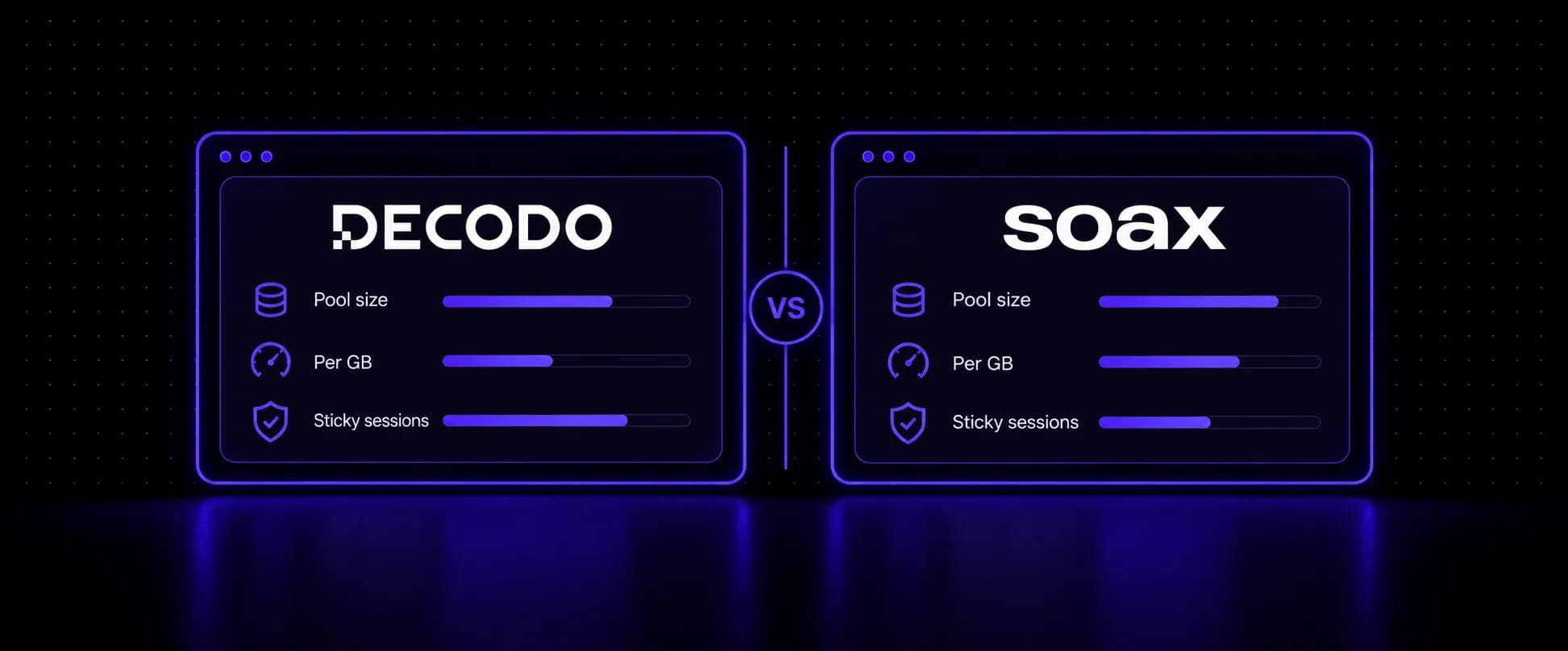
Decodo vs SOAX on mobile proxies comes down to two questions: how many gigabytes you buy each month, and how much verification you will accept before the first request. Decodo is cheaper up to 100 GB a month; SOAX is cheaper and larger above that, but requires identity verification. Both run large pools of real carrier IPs over HTTP, HTTPS and SOCKS5, but they split on entry price, pool size, targeting depth, identity checks and session behavior. Provider figures below come from each provider's own mobile proxy, pricing and help pages (Decodo, SOAX), checked on October 28, 2026, and covers mobile proxies only.
Key takeaways
- Decodo is the easier start: monthly plans from 2 GB at $3.75/GB, pay as you go at $4/GB, a free trial and a 14-day money-back window (the two don't combine).
- SOAX runs the larger mobile pool, 30M+ IPs in 195+ countries against Decodo's 10M+ in 160+ locations, and lists ZIP targeting and finer rotation rules.
- On published US rates, Decodo bills less up to 100 GB a month and SOAX bills less above that. Decodo's rates currently display as 50% off.
- SOAX's KYC policy makes identity verification a condition of paid access and requires it for crypto. On Decodo, crypto works for mobile, but banking, app stores, ticketing and other categories are blocked by default.
- Both sell metered access to shared pools of carrier devices, and neither lists a dedicated mobile device. That is the gap VoidMob covers.
Decodo vs SOAX at a Glance
Headline numbers first, then the full comparison. Pool figures are each provider's own claims.
| Feature | Decodo | SOAX |
|---|---|---|
| Mobile IP pool | 10M+ from 700+ carriers | 30M+ |
| Coverage | 160+ locations, US 3.9M+ IPs | 195+ countries |
| Targeting | Country, state, city, carrier/ASN | Country, region, city, ZIP, carrier, ASN |
| Entry option | 2 GB plan, $7.50/month | Free Sandbox, top-ups at $5/GB (US) |
| Lowest listed US rate | $2.25/GB on the 500 GB plan | From $0.85/GB on Enterprise ($3,000/month), lower in volume bands |
| Pay as you go | $4/GB | $5/GB in the US |
| Trial and refunds | Free trial, 14-day money-back | No trial, generally non-refundable |
| Sticky sessions | 1 to 1,440 minutes, 10 by default | Timed rotation 10 s to 1 week, ends after 60 s idle |
| Identity checks | Not required on mobile pages | Condition of paid access under KYC policy |
| Crypto payments | Accepted for mobile | After KYC |
| Dedicated mobile device | Not offered | Not listed |
Decodo Mobile Proxies: Pool, Pricing and Limits
Decodo, formerly Smartproxy, lists 10M+ mobile IPs from 700+ carriers across 160+ locations on 3G, 4G and 5G, per its mobile proxy pricing page. Its largest country pools are the US at 3.9M+ IPs, Germany at 1.2M+ and the UK at 940K+. Targeting runs from continent and country down to state, city and carrier or ASN.
Monthly plans start at 2 GB for $7.50 ($3.75/GB) and step down to 500 GB for $1,125 ($2.25/GB), with the 50 GB plan at $3/GB marked as the popular pick. Pay as you go costs $4/GB from a prepaid wallet and cannot run alongside a subscription. Every one of these rates displays as 50% off a struck-through list price, and VAT comes on top.
A free trial and a 14-day money-back guarantee appear on the pricing page, but the two don't combine: the trial terms put the pay-per-GB trial at 3 days and 100 MB with a card on file, pay as you go plans do not qualify, and the money-back option no longer applies once a trial is activated. Cards, PayPal, Google Pay, Apple Pay, Alipay and crypto are all accepted for mobile.
Sessions rotate per request or stick for 1 to 1,440 minutes, 10 by default. Decodo's own docs warn that longer sessions are more likely to rotate early because the mobile device behind them may go offline. Protocols are HTTP, HTTPS and SOCKS5, and a sticky SOCKS5 session needs a session parameter or the proxy rotates anyway. Its headline performance claim is a 99.75% success rate and under 0.5 seconds average response, though other figures appear in the same page's markup and FAQ.
The constraint to read before buying is target access. By default, Decodo blocks banking and financial, government, streaming entertainment, Apple and Google app stores, ticketing, gaming and telecom sites on every proxy type, with extra restrictions on mobile. ID verification opens mailing, streaming and business sites only on rotating residential plans, so mobile users request access case by case through compliance. For providers beyond these two, see our roundup of Decodo alternatives.
SOAX Mobile Proxies: Pool, Pricing and Limits
According to its developer docs, SOAX's mobile pool tops 30 million IPs from carriers in 195+ countries, and the website quotes 191M+ residential and mobile IPs combined. Targeting covers country, region, city, ZIP, carrier and ASN, so you can pin a session to one operator such as T-Mobile in one city.
Pricing is one rate across residential and mobile, set by the geo tier of the exit country, and the US sits in tier 1. US mobile traffic costs:
- Sandbox: free account, top-up credits at $5/GB
- Builder: $200/month at $3.00/GB
- Team: $500/month at $2.20/GB
- Scale: $1,500/month at $1.50/GB
- Enterprise Monthly: $3,000/month from $0.85/GB
One credit equals $1, and credits on monthly plans expire 60 days after purchase. VAT comes on top, there is no free trial, and payments are generally non-refundable.
Session control is where SOAX goes deepest. A session can rotate per request, on a timer from 10 seconds to a week, after a set number of requests or on error, and a bind-node option locks it to one device, returning an error if that device drops. Idle sessions expire after 60 seconds. Sandbox accounts get 4,000 concurrent connections per gateway.
Verification is the trade-off. SOAX's KYC and KYB Policy, in force since June 1, 2026, calls identity verification "a condition of access to the paid Platform." Crypto payments require personal KYC first, and SOAX's help center describes that check, plus restricted-domain access, as the two cases that need it. Restricted destinations, which include financial services and government sites by default, need ID verification, an Enterprise plan, a signed order form and business verification. Our SOAX alternative page compares US rates package by package.
What Decodo and SOAX Cost at Your Volume
Per-GB headlines hide minimums, so here is the bill at common volumes. The figures are arithmetic from published US rates, excluding VAT. Decodo's column uses its cheapest option at each volume, a monthly plan or pay as you go. SOAX's column uses the lowest-cost plan at each volume: the plan price plus top-up credits at $1 each, spent at that plan's tier 1 rate.
| Monthly traffic (US) | Decodo | SOAX | Lower bill |
|---|---|---|---|
| 2 GB | $7.50 (2 GB plan) | $10 (Sandbox) | Decodo |
| 25 GB | $81.30 (25 GB plan) | $125 (Sandbox) | Decodo |
| 50 GB | $150 (50 GB plan) | $200 (Builder) | Decodo |
| 100 GB | $275 (100 GB plan) | $300 (Builder + $100) | Decodo |
| 150 GB | $600 (pay as you go) | $450 (Builder + $250) | SOAX |
| 250 GB | $625 (250 GB plan) | $550 (Team + $50) | SOAX |
| 500 GB | $1,125 (500 GB plan) | $1,100 (Team + $600) | SOAX, narrowly |
| 1,000 GB | Contact sales | $1,500 (Scale) | SOAX |
Up to 100 GB a month, Decodo bills less, mostly because SOAX has no paid plan below $200. Above 100 GB the order flips: Decodo has no plan between 100 GB and 250 GB, so extra gigabytes go at the $4 pay as you go rate, which can't run alongside a subscription, and SOAX bills less from there on. At 1,000 GB SOAX's Scale plan has no published Decodo equivalent, since Decodo moves to a sales conversation above 500 GB. SOAX vs Decodo at volume also depends on where your traffic exits: SOAX's tier 2 and tier 3 countries cost less per GB than the US, while Decodo's mobile plans list one rate regardless of location.
Re-check the discount label
Decodo lists every mobile rate as 50% off a struck-through price. If that discount ends, its column roughly doubles and SOAX bills less at every volume in this table. Check both pricing pages on the day you buy, and remember that SOAX credits expire after 60 days.
Sticky Sessions: How Long Each Keeps One IP
Both providers route your traffic through carrier devices in a shared pool, devices neither one holds for you. That works for scraping and short logins, where the IP only has to last minutes. It shows at the edges: Decodo allows sticky sessions up to 24 hours but warns they may rotate early when the device goes offline, and SOAX's bind-node fails as soon as its node drops.
For account work, where one account should keep one carrier IP for weeks, neither pool is built for that job. The right mobile proxy for a job depends on how long it needs one IP, not on pool size. Our guide to sticky sessions on mobile proxies covers how long a session needs to last for each workflow.
Decodo vs SOAX: The Verdict
Decodo wins for most buyers under 100 GB a month. It has the lower entry point, pay as you go, a free trial, a money-back window, 24-hour sticky sessions and crypto without a stated ID step. SOAX wins on reach and scale: three times the mobile pool, 195+ countries, ZIP and carrier targeting, rotation rules down to the request count, and lower bills above 100 GB a month. The price is identity verification, a $200 monthly entry plan and credits that expire after 60 days.
Both leave the same gap. Each sells metered, per-GB access to a shared pool on devices neither holds for you, and both list only HTTP, HTTPS and SOCKS5 for mobile. Neither lists a dedicated mobile device, which is what account work needs: one account on one carrier IP for weeks, with a bill that doesn't grow with every page load.
VoidMob as a Decodo Alternative and SOAX Alternative
If you came here for a Decodo alternative or a SOAX alternative for account work, the missing piece is a dedicated mobile device. VoidMob's dedicated mobile device is reserved to you for the term with unlimited data, and its IP changes only when you rotate it from the dashboard, a private rotation link, the API or an MCP agent, or when the carrier reassigns it. It also runs more protocols than either pool lists: HTTP(S) and SOCKS5 with UDP, plus OpenVPN. Premium adds VLESS/Xray tunnels, a dedicated DNS resolver and p0f OS fingerprint control on every plan (Standard has p0f on plans tagged for it). For scraping, the rotating mobile pool bills per GB with no subscription, supports per-request, sticky and timed rotation, and carries UDP over SOCKS5, so apps that use QUIC can reach HTTP/3 sites.
| Mobile proxy edge | Decodo | SOAX | VoidMob |
|---|---|---|---|
| Dedicated mobile device | Not offered | Not listed | Reserved to you for the term |
| Billing | Per GB | Per GB, credits expire in 60 days | Unlimited data on dedicated, per GB on shared |
| How long one IP holds | Up to 24 h, may rotate early | Until 60 s idle or the node drops | Until you rotate it or the carrier reassigns it |
| Protocols listed for mobile | HTTP, HTTPS, SOCKS5 | HTTP, HTTPS, SOCKS5 | HTTP(S), SOCKS5 with UDP, OpenVPN; Premium adds VLESS/Xray |
| OS fingerprint (p0f) | Not listed | Not listed | Windows, macOS, iPhone or Android profiles |
| DNS | Not listed | Not listed | Dedicated resolver on Premium |
| Rotation control | Session ID and duration | Timed, request or error rules | Dashboard, rotation link, API, MCP agent |
| Identity check to buy | None stated on mobile pages | Condition of paid access | None, email or wallet signup |
| Mobile coverage | 160+ locations | 195+ countries | Fewer countries |
Proof points here are product facts. Every VoidMob exit is a real 4G/5G carrier address. On p0f plans, you can set the connection's TCP/IP fingerprint to Windows, macOS, iPhone or Android. Where VoidMob loses is breadth: Decodo and SOAX cover far more countries, so for mobile coverage across 160+ locations, pick one of them.
For a price to set against the tables above, here are VoidMob's current shared GB tiers and dedicated starting price:
Mobile proxy pricing
Shared pools from $3.99/GB, dedicated devices from $49/mo.
Prices updated
FAQ
Is Decodo better than SOAX for mobile proxies?
It depends on volume and verification. Under about 100 GB a month, Decodo is the better buy: a 2 GB entry plan, pay as you go at $4/GB, a free trial, a 14-day money-back window and crypto without a stated ID step. At high volume and for reach, SOAX is better, with a 30M+ mobile pool in 195+ countries, ZIP targeting and lower bills above 100 GB a month, but it requires identity verification for paid access.
How much do Decodo mobile proxies cost?
As of October 28, 2026, Decodo mobile plans run from 2 GB at $3.75/GB ($7.50 a month) to 500 GB at $2.25/GB ($1,125 a month), and pay as you go costs $4/GB. All rates display as 50% off a list price and exclude VAT. Larger volumes go through sales.
How much do SOAX mobile proxies cost?
One rate covers residential and mobile, set by the exit country's tier. For US traffic as of October 28, 2026: Sandbox top-ups at $5/GB, Builder at $200 a month for $3.00/GB, Team at $500 for $2.20/GB, Scale at $1,500 for $1.50/GB and Enterprise Monthly from $0.85/GB at $3,000. Prices exclude VAT, and plan credits expire after 60 days.
Does SOAX require KYC?
Yes for most paid use. SOAX's KYC and KYB Policy, effective June 1, 2026, makes identity verification a condition of access to the paid platform. Its billing docs require personal KYC before crypto payments, and restricted destinations need ID verification, an Enterprise plan and business verification.
Does Decodo offer a free trial for mobile proxies?
Yes, a free trial is advertised on its mobile proxy plans. Decodo's help center describes pay-per-GB trials as 3 days with 100 MB, a card required, and pay as you go plans excluded. A 14-day money-back guarantee is listed as well, but it no longer applies once a trial is activated.
Which has more mobile IPs, Decodo or SOAX?
SOAX, on the providers' own figures. Over 30 million mobile IPs across 195+ countries are stated in SOAX's documentation, while Decodo lists 10M+ mobile IPs from 700+ carriers in 160+ locations, including 3.9M+ in the US. Pool size matters less than coverage in the countries you actually target.
What is the best Decodo alternative or SOAX alternative for mobile proxies?
For account work, the stronger alternative to either is a dedicated mobile device rather than another shared pool. VoidMob rents dedicated 4G/5G mobile devices with unlimited data, an IP that holds until you rotate it or the carrier reassigns it, and HTTP(S), SOCKS5 with UDP and OpenVPN access (VLESS/Xray on Premium), alongside a per-GB rotating mobile pool. For the widest country coverage, Decodo and SOAX remain the larger networks.
Choose by the job rather than the pool size:
- Testing, or under 100 GB a month: Decodo.
- High volume, ZIP targeting or 195+ countries: SOAX.
- Accounts that need one carrier IP for weeks, unlimited data, UDP or VLESS/Xray: VoidMob.
Need one carrier IP for weeks?
Reserve a dedicated 4G/5G mobile device with unlimited data, or start on the per-GB rotating pool.